

Our Latest Blogs
Tips, reviews and tech insights from our team.
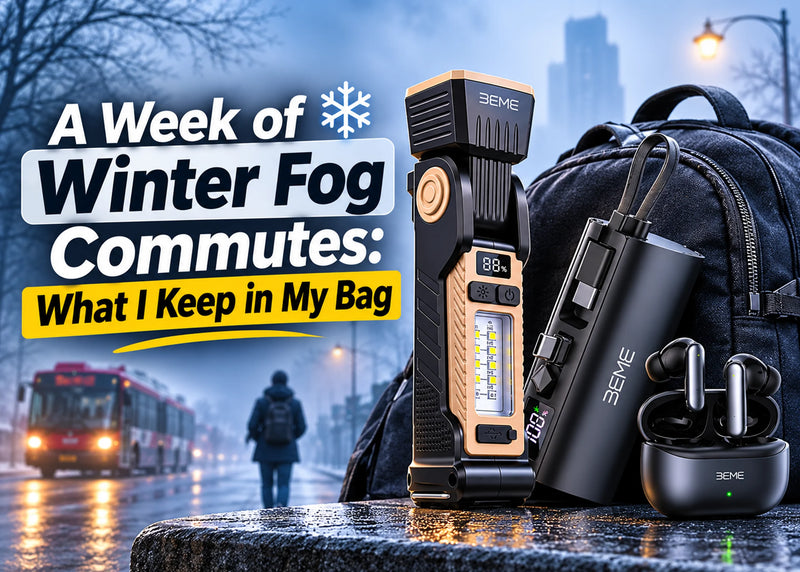
Fog changes a commute completely. The road looks different, buses run late, the walk from the stop feels longer, and a dead phone becomes a real problem instead of a small annoyance. After a few foggy weeks, I settled on three small things I keep in my bag every day. None of them is dramatic. Each one solves a specific problem, and this is how a typical week with them goes, including the places where they fall short. What Is in the Bag A small magnetic light with a seat belt cutter, the BEME UTLI Light. A pocket power bank with a built in cable, the BEME Explorer Mini 3. Noise cancelling earbuds with a transparency mode, the BEME Elite Buds Pro 3. Monday and Tuesday: The Light The first fog morning, I realised my phone torch was a poor choice. It drains the battery I need for maps and calls, and it is awkward to hold while carrying a bag. A small dedicated light solves both. The BEME UTLI Light Multi Functional Flashlight clips to my bag with the carabiner hook, and has a 90 degree swivel head, 5 light modes, and 4 brightness levels. It also has a magnetic holder, which is handy if I stop at a car or a steel gate. It is priced at Rs. 2,799, down from Rs. 3,999, and the page lists it as in stock. The honest part is the battery. BEME lists about 1.5 to 2 hours of life and about 5 hours to charge, so I charge it on Sunday night and use the lower brightness for walking. It is a short burst light, not an all evening one. It also includes a seat belt cutter, which I hope never to use, but it sits in the bag for the days I travel by car. Fog does not make a torch see far, so I use it to be seen and to check my footing, not to look down the road. Wednesday: The Power Bank By Wednesday afternoon, fog delays had eaten my battery. Maps, messages, and a long wait for a late bus took my phone from full to 15 percent by 4 pm. This is exactly the moment a power bank without a cable is useless, because the cable is always at home. The BEME Explorer Mini 3 5000mAh Powerbank has a built in Type C cable, a rotatable Type C connector, and a Type C to Lightning converter in the box, so it works with whichever phone I have. It has an LED display, a foldable stand, and PD output of 22.5W, and it is priced at Rs. 3,499, down from Rs. 4,999. The page lists it as in stock. At 18.5Wh, it gives roughly one partial to full phone charge, which is enough to get me home. It is not for long outages. I charge it overnight, since the Type C input accepts about 18W, and a full refill takes around an hour or two. Thursday: The Earbuds Fog makes people careless. Traffic noise sounds different, drivers brake late, and you notice sounds more than sights. Walking with noise cancelling on, I realised I could not hear a motorbike coming from behind. This is where transparency mode earns its place. The BEME Elite Buds Pro 3 combine ANC and ENC with a transparency mode. According to BEME's touch guide, three taps switch between ANC and transparency, so I can change it without taking out my phone. I use noise cancelling inside the bus, and transparency on the road. They run on Bluetooth 6.0, and BEME lists up to 25 hours of total playback with the case. One buyer reported around 4 to 5 hours from the earbuds alone, so I keep the case charged. They are priced at Rs. 4,999, down from Rs. 9,999, and the page lists them as in stock. The honest part is the safety rule. Even with transparency mode, I keep the volume low on a road, since it is not the same as hearing normally. Friday: What I Would Change By the end of the week, I had a few lessons. Charge everything on Sunday night. A light, a power bank, and earbuds only help when they are charged. Keep the light on a lower setting to save the battery. Do not rely on noise cancelling near traffic. Wear something bright or reflective in fog, since a small light does not replace being visible. Slow down. No accessory makes fog safe. What It Costs The three items together come to Rs. 11,297, using current listed prices. You do not have to buy all three. I would start with the one that fixes your biggest problem, which for me was the dead phone. Who This Setup Suits People who walk or wait outdoors in fog. Commuters who take buses or rickshaws and rely on their phones. Students and office workers who carry a bag every day. Before You Buy Check the current price and stock on each product page, since BEME prices change during sales. Decide whether the short battery of the light suits your use, and whether 5000mAh is enough for your day. The Takeaway Three small items, a light, a power bank, and earbuds, will not make fog safe, but they remove the small problems that make fog commutes worse. Charge them on Sunday, use them sensibly, and keep your eyes and ears open.
Read Article
A rechargeable flashlight is one of the most useful things in a home or a car, and one of the easiest to neglect. It sits in a drawer for months, the battery drains, someone leaves it in a hot car, and the next time you need it, it is dead. The good news is that a few small habits keep a flashlight working for years. This guide covers charging, storage, heat, cleaning, and water, with notes for three BEME lights. How the Battery Works Most rechargeable flashlights use lithium ion batteries, often a cell called an 18650. These batteries last longest when they are not pushed to extremes. They dislike heat, long periods fully drained, and being left on charge for days. They also slowly lose capacity with every charge cycle, which is normal. Good habits slow that loss. Charging Habits That Help Charge before the battery is completely empty, when you can. Unplug it when it is full, and do not leave it on charge for days. Use a normal 5V charger, such as a phone charger, and a good cable. Charge on a hard surface, away from bedding, and not near anything flammable. Do not charge a flashlight that is wet or very hot. Do not leave it charging unattended overnight if you can avoid it. Storage Habits That Help If you will not use it for months, store it with a partial charge, around half, not empty and not full. Check it every two or three months, and top it up if the charge has dropped. Keep it in a cool, dry place, away from direct sun. Never leave it in a parked car in summer. A closed car in a Pakistani summer gets hot enough to damage a battery. Avoid leaving it in freezing temperatures, and warm it to room temperature before charging. Use Habits That Help Avoid running it on the highest brightness continuously, since high output heats the battery and the body. Use lower modes for everyday tasks to save the battery. If the light flickers or dims quickly, charge it before it goes completely dead. Do not open the flashlight. BEME does not state whether the batteries in these lights are user replaceable, so leave repairs to the seller. Cleaning and Water Wipe the body with a dry or lightly damp cloth, and wipe the lens gently so it does not scratch. Clean the Type C port with a dry soft brush or a wooden toothpick when the power is off. Never use metal pins. Do not rinse a flashlight under a tap unless its rating allows it, and even then, dry it thoroughly. A rating such as IPX4 means splash resistance, not submersion. BEME Torch Light Ultra The BEME Torch Light Ultra Tactical Flashlight uses a rechargeable 18650 battery, an aluminum alloy and ABS body, and charges over Type C in about 1 to 2 hours. BEME lists up to 9 hours of runtime in power saver mode. A buyer reported around 60 to 90 minutes at maximum brightness, so use the lower modes for longer life. It is priced at Rs. 2,199, down from Rs. 3,000, and the page lists it as in stock. Since it is a long range torch, keep the lens clean, and store it partly charged if it will sit in a drawer. BEME UTLI Light The BEME UTLI Light Multi Functional Flashlight has a 1200mAh 18650 battery, a magnetic holder, and a built in seat belt cutter. BEME lists about 5 hours to charge and about 1.5 to 2 hours of battery life, so it needs regular topping up. It is priced at Rs. 2,799, down from Rs. 3,999, and the page lists it as in stock. Because it lives in a glovebox, keep it out of direct summer heat, check its charge every month, and keep the magnetic base clean of metal dust. Also check that the seat belt cutter is dry and free of rust or dirt, and know how to use it before you need it. BEME Tool Beam The BEME Tool Beam Multi Functional Flashlight has a 1200mAh 18650 battery, an IPX4 rating, a tripod, and a COB side lamp. It charges over Type C at 5V and 500mA, which takes about 5 hours, so plan ahead. It is priced at Rs. 2,499, down from Rs. 3,999, and the page lists it as in stock. IPX4 handles splashes, so wipe it dry after outdoor use, keep the tripod legs clean and free of grit, and store it indoors. A Yearly Check Charge and test every light you own. Check the body for cracks, the port for dirt, and the switch for smooth action. Replace any light that heats up while idle, smells unusual, or has a swollen body. Keep a note of when you last charged each one. Warning Signs Stop using a flashlight and contact the seller if it gets very hot, smells of burning, swells, leaks, or will not charge at all. Do not keep charging a swollen light. Dispose of damaged batteries through a proper recycling point and not with household waste. The Takeaway A flashlight lasts when it is treated like a small battery powered device, not like a toy. Charge it sensibly, store it partly charged in a cool place, keep it clean and dry, and check it once in a while. Do that, and it will be ready every time you need it. Check the current prices on the product pages, since BEME prices change during sales.
Read Article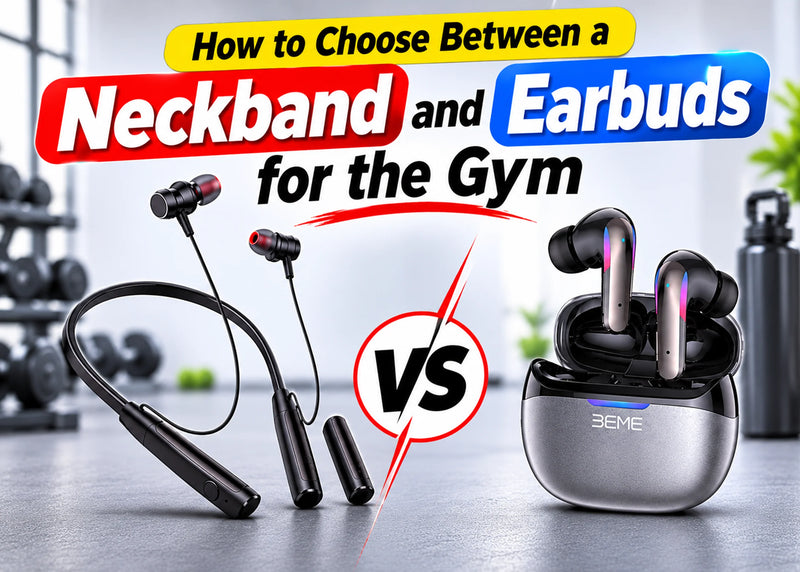
Walk into any gym in Pakistan and you will see both. Some people wear neckbands that stay put through every rep. Others wear small earbuds that vanish into the ear. Both work, and both fail in different ways. Instead of arguing about which is better, answer three simple questions about how you train. Your answers will point to the right choice, and this guide shows which BEME option fits each answer. Question One: How Hard Do You Move and Sweat? A gym earphone has to survive movement and sweat. This is the question that rules things in or out. If you run, jump, do burpees, or train hard, a neckband is the safer choice. It hangs around your neck, so even if an earpiece pops out, it does not fall to the floor. Earbuds can work, but they depend on a good seal, and a loose pair will slip during high impact moves. Then check the water resistance rating. IP54 covers splashes and sweat. IP65 is dust tight and handles low pressure water jets. Neither is for swimming or a long rinse. The BEME NeckWave 2 Voice Changer Wireless Neckband lists an IP65 rating, which makes it the strongest pick here for heavy sweat. It also has ENC, 16mm drivers, Bluetooth 5.3, and up to 24 hours of playback, and is priced at Rs. 3,199, down from Rs. 4,999. The page lists it as in stock. Question Two: How Often Can You Charge? Be honest about your habits. If you forget to charge, or you train daily, battery life matters more than any other spec. Neckbands have the advantage, since the band holds a larger battery. Earbuds are limited by their size, and they rely on the case for extra charges. A buyer of the Elite Buds Pro 3 reported around 4 to 5 hours from the earbuds alone, with the case adding more. For the longest battery, the BEME NeckWave Marathon lists up to 100 hours of playback on Bluetooth 5.4, with ENC and 16mm drivers. It is priced at Rs. 4,999. If you want to swap batteries instead, the BEME NeckWave Pro has a detachable dual battery with a spare in the box, up to 50 hours of playtime, and an IP54 rating. It is priced at Rs. 3,999, down from Rs. 4,999. Check which fits you. If you hate charging, the Marathon removes the worry. If you like control, the Pro lets you swap a fresh battery in seconds. Question Three: What Else Do You Need From Them? Some people want only music. Others take calls, walk to the gym, or train outdoors near traffic. This question decides the features. Earbuds like the BEME Elite Buds Pro 3 offer ANC and ENC, a transparency mode that lets outside sound in, a voice changer for calls, Bluetooth 6.0, and up to 25 hours of total playback with the case. They are priced at Rs. 4,999, down from Rs. 9,999, and the page lists them as in stock. They suit people who take calls, train in noisy gyms, or want to hear their surroundings on outdoor runs. Check the page for a water resistance rating before using them in heavy sweat, since it is not the main selling point. Gym Specific Details Most People Miss Barbell work. A neckband sits behind your neck, so it can be in the way during squats or any lift with a bar across your back. Earbuds avoid this. Lying down. On a bench, a neckband can press against your neck, while earbuds can press into the pillow of a bench. Try both for comfort. Heat and sweat. A band around a sweaty neck can feel warm in Pakistan's heat. Earbuds feel cooler. Safety. If you run outdoors, keep the volume low enough to hear traffic, or use transparency mode. Hygiene. Wipe the neckband or earbuds after each session and let them dry before charging. Your Quick Result If you train hard, sweat a lot, and forget to charge, choose a neckband. The NeckWave 2 is the sweat pick, the Marathon is the battery pick, and the Pro is the swap pick. If you do lighter training, take calls, and want noise control or transparency, choose earbuds. The Elite Buds Pro 3 covers those features. If you do heavy squats or barbell work, lean toward earbuds. If you are unsure, start with the NeckWave 2, since it is the lowest priced and has the highest listed water resistance. Honest Limits Neither style is perfect. Neckbands can bounce on very high impact moves and can feel warm. Earbuds can slip and need more frequent charging. Noise cancellation at these prices softens noise and does not silence a gym. Sound quality is good for training, not for critical listening. A Quick Buying Checklist Check the water resistance rating. Check the battery life for your routine. Try the fit in your own ears or around your neck. Check the warranty and the seller. Check the current price and stock on each product page, since BEME prices change during sales. The Takeaway The right gym earphone depends on three honest answers, how you move, how you charge, and what else you need. Answer them first, and the choice usually becomes clear.
Read Article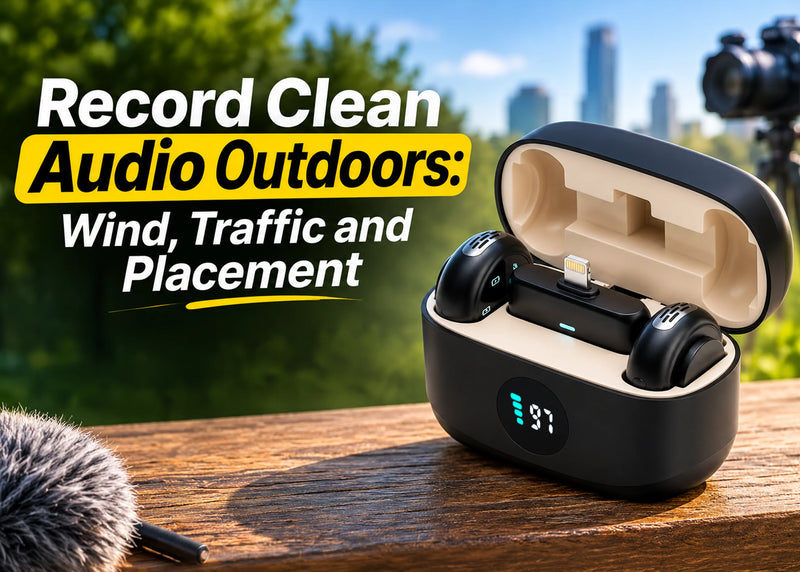
Shooting outdoors looks great and sounds terrible, unless you plan for it. Wind rumbles, traffic drowns your voice, and a microphone clipped in the wrong place picks up everything except you. The good news is that most outdoor audio problems come from three things, wind, noise, and placement, and all three have simple fixes. This guide covers them in order, using the BEME Mic Go 3 Dual Wireless Microphones as a worked example, so you can see which features help and which do not. What the Mic Go 3 Brings BEME lists the Mic Go 3 as two wireless microphones with one receiver, compatible with Lightning and Type C devices. It lists a noise reduction mode toggled by the side button, a sensitivity of minus 38dB, a frequency response of 20Hz to 20kHz, a signal to noise ratio of 70dB or better, audio delay of 20ms or less, and about 10 to 30 meters of transmission. The microphones run about 6 hours, and a 300mAh case charges them. It also supports headset listening, so you can hear what you are recording. BEME lists it at Rs. 4,999, down from Rs. 7,999, on its home page as a newly launched product. Check the current price and stock on the product page. Problem One: Wind Wind is the biggest enemy of outdoor audio. When air blows across a microphone, it creates a loud rumbling sound that cannot be fully removed afterward. Noise reduction does not fix it. The fix is physical. Use a foam cover or a furry windscreen on the microphone. No windscreen is listed in the Mic Go 3 box, so plan to buy one. Stand with the wind at your back or side, not in your face. Use your body as a shield. A microphone on your chest, behind a jacket flap, catches less wind. Shoot in a sheltered spot, such as beside a wall or a car. If the wind is strong, move or wait. Problem Two: Traffic and Crowds Traffic noise is constant, and no microphone can remove it completely. What you can do is make your voice louder than the noise by keeping the microphone close to your mouth. Place the microphone about 15 to 20 centimeters from your mouth, which is about a hand's width below your chin. Face away from the road if you can, so your body blocks some of the sound. Choose quieter spots, such as a park, a rooftop, or a side street, and avoid shooting next to a busy road. Turn on the noise reduction mode. The Mic Go 3 toggles it with the side button. It helps with steady sounds like engines, but cannot remove sudden loud noises like horns. Record a few seconds of silence in the same place, which helps if you clean up the audio later. Problem Three: Placement A microphone in the wrong place gives bad audio even in a quiet room. Clip it to the middle of your chest, not to the side of your collar. Keep it facing your mouth, and keep it away from necklaces, scarves, and cloth that rubs. For a guest, put the second microphone on them, in the same way, and check both levels. Keep the microphone and the phone in line of sight, since bodies and walls reduce range. Do not let hair or a hand cover the microphone. Monitor and Test Use headphones to listen while you record, when your setup allows. The Mic Go 3 lists headset listening, and it lets you hear problems such as wind or rustling before it is too late. Also record a 30 second test and play it back before every shoot. Check hiss, rustling, drops, and volume. Phone Setup Notes BEME's setup guide gives a few key points. Plug the receiver into your phone's port, and press and hold the power button to switch the microphone on. On Oppo, Vivo, iQOO, and Realme phones, turn on OTG in the phone settings first. Check that your camera app is using the external microphone. Also take off a thick case if it stops the receiver seating fully. Battery and Power Six hours is enough for most shoots, but charge the microphones and the case the night before. The receiver also occupies your phone's charging port, so you cannot plug in a cable while recording. Take a charged phone, and if your phone supports magnetic charging, a power bank such as the BEME Dual Mag 5000mAh Wireless Power Bank can keep it topped up wirelessly. It is priced at Rs. 3,999, down from Rs. 7,999. Recording video while wireless charging can warm the phone, so test it first. A Simple Outdoor Checklist Fit a windscreen. Charge the microphones, the case, and the phone. Pick a spot away from traffic and wind. Clip the microphone to your chest, 15 to 20 centimeters from your mouth. Turn on noise reduction and check the levels. Record a 30 second test and listen on headphones. Record the real take, and a backup if it matters. Fixing Audio Afterward If the audio is slightly noisy, a basic noise reduction and a volume balance in an editing app can help. Do not overdo it, since heavy processing makes a voice sound thin and robotic. It is always better to fix the problem at the source than to rescue it in editing. The Takeaway Clean outdoor audio comes from three habits. Block the wind, get the microphone close to your mouth, and test before you record. A good microphone helps, but placement and wind protection matter just as much. Do those well, and your reels and vlogs will sound far better.
Read Article
Every winter, the same complaint appears. A phone that showed 40 percent in a warm room suddenly drops to 10 percent outside, and the power bank seems to give far less than it should. The good news is that cold weather does not ruin a power bank in most of Pakistan. The bad news is that it does reduce what you get, and one common mistake can cause real damage. This guide explains what happens in the cold, what to avoid, and how to use a power bank properly in winter. What Cold Does to a Battery Power banks use lithium ion batteries, and these batteries work through chemical reactions. In the cold, those reactions slow down. The battery has more internal resistance, so it delivers less power, and it seems to run out faster. This is mostly temporary. When the power bank warms up, most of the lost capacity comes back. The same thing happens to your phone, which is why phones shut off suddenly in freezing weather even when they show a charge. How Cold Is Cold Most of Pakistan has mild winters, with temperatures well above freezing in the plains. In cities like Lahore, Karachi, and Islamabad, a power bank in your bag will behave almost normally. The effects matter more in the north, in places like Murree, Hunza, Skardu, and Naran, where temperatures fall near or below zero, especially at night and at altitude. BEME does not publish an operating temperature range for its power banks on the product pages, so check the manual or ask the seller. As a general guide, lithium ion batteries tend to discharge reasonably well below freezing but should not be charged when they are below zero. The One Thing Never to Do Do not charge a frozen power bank. Charging a lithium battery below freezing can cause permanent damage inside the cell and can be unsafe. If your power bank has been outside in freezing weather, let it warm up to room temperature slowly before you plug it in. Do not speed it up with a heater, a hair dryer, or by putting it on a radiator. A slow warm up inside a pocket or a bag is enough. Winter Habits That Help Keep the power bank in an inner pocket, close to your body, instead of an outside pocket or the car. Charge it fully before you leave, since a warm, full battery handles the cold better. Keep your phone warm too, since it is usually the phone that shuts down first. Do not leave electronics in a parked car overnight. If a device shuts down in the cold, warm it in your hands before restarting it. Expect a shorter run time than in summer, and carry more capacity than you think you need. A Large Capacity Buffer: BEME Nomad 30000mAh Because cold reduces the usable capacity, a bigger battery gives you a margin. The BEME Nomad 30000mAh Power Bank stores about 111Wh, and has a Type C port with 20W Power Delivery output, two USB A ports with up to 22.5W output, and an LCD display that shows the remaining battery. It is priced at Rs. 6,999, down from Rs. 9,999, and the page lists it as in stock. Keep it in a warm bag on cold days, and charge it indoors. A power bank of this size also takes long to refill, roughly seven to nine hours at about 18W, so charge it the night before. A Pocket Power Bank for Daily Winter Use: BEME Dual Mag For daily use in a coat pocket, a small power bank is more practical. The BEME Dual Mag 5000mAh Wireless Power Bank has 20W Type C wired charging and 10W magnetic wireless charging, and snaps onto a compatible phone. It is priced at Rs. 3,999, down from Rs. 7,999, and the page lists it as in stock. Keeping the power bank attached to the phone in an inner pocket keeps both warm. In very cold weather, wired charging is more reliable than wireless, which loses more energy as heat, so use the Type C port for a quick top up. For Trips to the North: BEME Photon Ultra Plus On a northern trip, you may be far from a socket for days. The BEME Photon Ultra Plus Solar Powered 30000mAh Powerbank adds solar charging and a hand crank generator to its 30,000mAh battery, with a shockproof, waterproof, and dustproof build and an LED torch with SOS. It is priced at Rs. 9,499, down from Rs. 14,999, and the page lists it as in stock. Be realistic about winter solar. The winter sun is weaker, clouds and fog cut it further, and BEME does not publish the panel's wattage, so treat solar as a small top up and the hand crank as an emergency option. The stored battery is what carries you. Signs to Stop Using a Power Bank It looks swollen or bulging. It becomes very hot or smells unusual. It was frozen and you charged it before it warmed up. It shows damage after a drop. If any of these apply, stop using it and replace it. A Quick Winter Checklist Charge fully before you leave. Keep it warm and close to your body. Never charge it while frozen. Carry a little more capacity than usual. Check the manual for the operating range of your model. Check the current price and stock on the product pages, since BEME prices change during sales. The Takeaway Cold weather makes a power bank less capable for a while, but it does not break it. Keep it warm, never charge it while frozen, and carry a bigger battery if you will be outside for long. With those habits, winter is no problem.
Read Article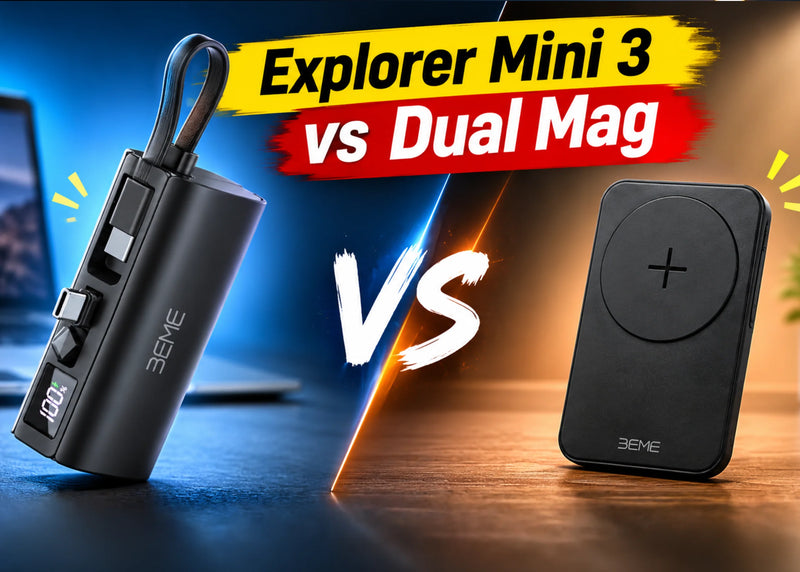
BEME has two small power banks with the same 5000mAh battery but very different ideas. One carries its own cable. The other snaps onto your phone and charges without one. They cost about the same, so the choice comes down to how you charge. This guide compares them using their product pages, shows where each is stronger, and tells you which fits which person. Quick Answer Choose the Explorer Mini 3 if you want a built in cable, a Lightning converter, and the lowest price. Choose the Dual Mag if you have an iPhone 12 or newer, want cable free charging, or use a magnetic car mount. Both are listed as in stock. BEME Explorer Mini 3 The BEME Explorer Mini 3 5000mAh Powerbank is priced at Rs. 3,499, down from Rs. 4,999. It stores 18.5Wh. BEME lists a built in Type C cable with PD output of 22.5W, and a rotatable Type C connector with PD output of 20W. A Type C to Lightning converter comes in the box. It has a real time LED battery display, a built in foldable stand, and a Type C input that accepts about 18W. Its strength is simplicity. You never carry a cable, and one small power bank works with Type C phones and, through the converter, Lightning iPhones. BEME Dual Mag The BEME Dual Mag 5000mAh Wireless Power Bank is priced at Rs. 3,999, down from Rs. 7,999. It has 20W Type C wired charging and 10W magnetic wireless charging, a dual sided magnetic design, and magnetic pogo pin charging for recharging the power bank itself. It is compatible with magnetic car vent mounts. Its strength is convenience. It snaps onto the back of a compatible phone and charges without a cable. Side by Side Price. The Explorer Mini 3 costs Rs. 500 less. Cable. The Explorer Mini 3 has a built in cable. The Dual Mag needs your own cable for wired charging. Wireless. Only the Dual Mag offers magnetic wireless charging, at 10W. Wired speed. The Explorer Mini 3 lists up to 22.5W on its cable. The Dual Mag lists 20W on its Type C port. Lightning. The Explorer Mini 3 includes a converter. The Dual Mag uses Type C, so a Lightning iPhone needs a cable. Phone fit. The Dual Mag works natively with iPhone 12 and newer. Other phones need a magnetic ring case for the magnet to hold. Stand. The Explorer Mini 3 has a foldable stand. Car use. The Dual Mag is compatible with magnetic car vent mounts. Weight and airline rules. Both are small, and the Explorer Mini 3 is listed at 18.5Wh, far below airline limits. The Dual Mag has the same battery size. Which One Fits You If you use an Android phone, choose the Explorer Mini 3. The magnet of the Dual Mag needs a ring case, and the built in cable works with no extras. If you have an older iPhone with Lightning, choose the Explorer Mini 3 for its converter. If you have an iPhone 12 or newer and like snapping things on, choose the Dual Mag. If you use your phone in the car for maps, the Dual Mag with a magnetic mount keeps it charged and in place. If you forget cables, choose the Explorer Mini 3. If you charge at your desk while using the phone, the Dual Mag's magnet keeps the phone free of cables. The Honest Limits Both power banks give roughly one partial to full phone charge, so they suit daily top ups, not long outages or multi day trips. The Dual Mag's wireless charging is slower than wired and warms the phone more, and a thick case can weaken its magnetic hold. The Explorer Mini 3's built in cable is convenient, but a built in cable can wear over time, and you cannot replace it if it fails. If you use the Explorer Mini 3's cable, handle it gently. What Buyers Say The Explorer Mini 3 page shows 7 reviews, all five stars. Buyers mention that it is travel friendly, that the LED display shows exact battery percentage, and that the Lightning converter and foldable stand are useful. These are early reviews of a newly listed product, so judge it on the specs too. If You Need More Than 5000mAh For longer days, the BEME Nomad 30000mAh Power Bank stores about six times the energy at Rs. 6,999, but it is much larger and has no built in cable. A Quick Buying Checklist Check your phone's port and whether it supports magnetic charging. Decide whether a built in cable or a cable free design matters more. Check the case you use, since a thick case weakens a magnet. Check the current price and stock on each page, since BEME prices change during sales. The Takeaway The two power banks solve the same problem from opposite sides. The Explorer Mini 3 removes the cable. The Dual Mag removes the wire connection altogether. Choose the one that fits your phone and your habits, and you will use it every day.
Read Article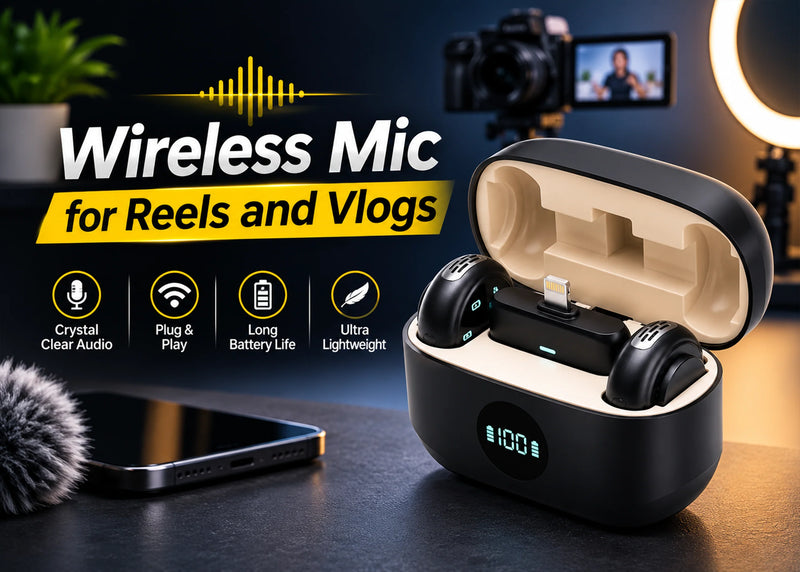
Viewers forgive average video much faster than bad audio. A phone microphone picks up the room, the traffic, and the wind just as clearly as your voice, which is why many creators in Pakistan move to a wireless mic as their first upgrade. But the spec lists can be confusing, and a mic that sounds great in a demo can fail on your phone. This guide explains what to check, using the BEME Mic Go 3 Dual Wireless Microphones as a worked example, with notes on where it is strong and where to be careful. What the Mic Go 3 Offers BEME lists the Mic Go 3 as a dual wireless microphone system for vloggers, interviews, and everyday recording. Here are the main specifications. Two wireless microphones and one receiver, listed as Type C and iPhone compatible. Lightning and Type C compatibility, so it works with supported iPhones and Android phones. Wireless transmission of about 10 to 30 meters. Audio delay of 20ms or less. Microphone sensitivity of minus 38dB, plus or minus 3dB. Frequency response of 20Hz to 20kHz, and a signal to noise ratio of 70dB or better. A noise reduction mode you toggle with the side button. About 6 hours of battery life for the microphones, and a 300mAh charging case. A digital display for battery and working status, plus headset listening and a reverberation function. BEME lists it at Rs. 4,999, down from Rs. 7,999, on its home page as a newly launched product. Check the current price and stock on the product page. Check One: Does It Fit Your Phone The receiver plugs into your charging port, so connection matters first. iPhone 15 and newer use Type C. Older iPhones use Lightning, and the Mic Go 3 lists support for both. For Android, most phones use Type C. BEME's setup instructions add an important note. On Oppo, Vivo, iQOO, and Realme phones, you must turn on OTG in the phone settings first. If a mic seems dead on one of these phones, this setting is usually the reason. Check Two: Real Range, Not the Biggest Number A range of 10 to 30 meters is a band, not a promise. Walls, crowds, and body position all reduce range. For reels and vlogs, you are usually within a few meters of the phone, so range is rarely the problem. Test it in the place you will actually shoot. Check Three: Delay and Sync Audio delay matters if the voice drifts out of sync with your lips. A delay of 20ms or less, as listed, is small enough that most people will not notice it. As always, test a short clip before a long shoot. Check Four: Noise Reduction and Wind Noise reduction helps with background sounds such as traffic hum and fans. It cannot remove wind. Wind noise hits a microphone as a loud rumble, and the best fix is a foam or furry cover. No windscreen is listed in the Mic Go 3 box, so if you shoot outdoors, plan to buy one. Also clip the mic close to your mouth, about a hand's width below your chin, and away from your collar to avoid rustling. Check Five: Battery BEME lists about 6 hours for the microphones, with a 300mAh case that tops them up. Six hours is plenty for most shoots, but charge everything the night before, and carry the case with you. Check Six: Powering the Phone While You Record This is the detail most buyers miss. The receiver sits in your phone's charging port, so you cannot plug in a charging cable at the same time. Long videos drain a phone quickly, especially at high resolution. If your phone supports magnetic or wireless charging, a magnetic power bank keeps it topped up while the receiver stays plugged in. The BEME Dual Mag 5000mAh Wireless Power Bank offers 10W magnetic wireless charging, and snaps onto an iPhone 12 or newer, or on other phones with a magnetic ring case. It is priced at Rs. 3,999, down from Rs. 7,999, and the page lists it as in stock. Honest notes: recording video while charging wirelessly can make a phone warm, and 10W may not keep up with very demanding recording. Test it first, and take breaks if the phone gets hot. Check Seven: Record a Test, Every Time Before any important shoot, record a 30 second test and listen on headphones. Check for hiss, rustling, drops, and volume. Also check that your camera app is using the external mic, since some apps default to the phone microphone. Tips for Better Audio Keep the mic about 15 to 20 centimeters from your mouth. Record in a quiet room if you can, and avoid bare walls that echo. Use the second mic for a guest, and test both together. Keep the receiver and the phone clear of thick cases that stop the plug seating fully. Keep a backup plan, such as recording a second take. A Quick Buying Checklist Confirm your phone's port, and your phone's OTG setting if it is an Oppo, Vivo, iQOO, or Realme. Check the box for a windscreen, and buy one if it is missing. Check battery hours and the case's capacity. Check the warranty and the seller. Check the current price and stock, since BEME prices change during sales. The Takeaway A good wireless mic makes you sound clear and professional, and it is one of the cheapest ways to improve a video. Check the connector, the OTG setting, wind protection, and your phone's battery before you shoot, and test every time.
Read Article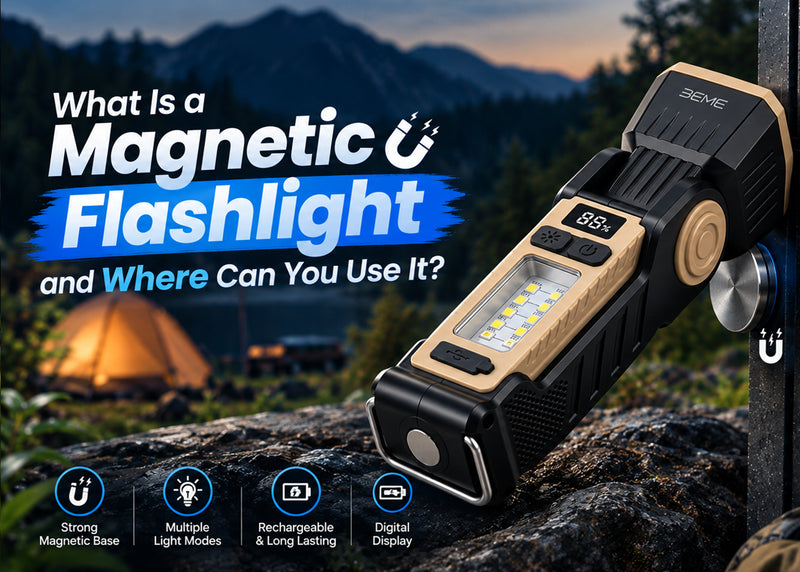
Most flashlights have one big problem: you need a hand to hold them. Changing a tyre, checking an engine or fixing a wire with one hand is slow and frustrating. A magnetic flashlight solves that. It sticks to metal surfaces, so the light stays in place while both your hands do the work. In this guide, we explain what a magnetic flashlight is, how it works, where you can use it and what to look for before buying one. What Is a Magnetic Flashlight? A magnetic flashlight is a torch with a built in magnet, usually in its base, tail or holder. The magnet lets you attach the light to any steel or iron surface, such as a car body, a toolbox or a metal cabinet. Once attached, the flashlight works hands free. Many models also have an adjustable head, so you can aim the light exactly where you need it after mounting. How Does a Magnetic Flashlight Work? The idea is simple. A permanent magnet inside the flashlight pulls towards ferromagnetic metals, mainly iron and steel. The magnet holds the flashlight in place without screws, clamps or tape. Magnets do not stick to: Aluminium Most plastics, including car bumpers Glass and wood Some types of stainless steel Some modern cars use aluminium bonnets or plastic panels, so it helps to check which parts of your car are steel. Where Can You Use a Magnetic Flashlight? 1. Changing a Tyre at Night Attach the flashlight to the car body near the wheel arch and aim it at the tyre. You get steady light while you use the jack and spanner with both hands. 2. Checking Under the Car Bonnet Stick the light to the inside of a steel bonnet or a metal part nearby, then point it at the engine. It is much easier than holding a phone torch in your mouth or asking someone to hold it. 3. Bike Repairs Motorcycle frames, fuel tanks and toolboxes often have steel parts. A magnetic light frees your hands for chain, brake and wiring checks. 4. Home Repairs and Load Shedding Attach it to a metal fuse box, a steel cupboard or the fridge side during an outage. It turns into a fixed light for the room or for a quick electrical job. 5. Workshops and Garages Mechanics and electricians use magnetic lights on tool trolleys, machines and steel benches to light up tight spaces. 6. Camping and Outdoor Trips Stick it to a car door or a metal camping table to light up your setup area after dark. What to Look for in a Magnetic Flashlight Strong Magnetic Hold The magnet should hold the light firmly, even when the head is tilted. A weak magnet can slip and fall. Adjustable Head An adjustable or rotating head lets you aim the light after it is attached. Without it, you are limited to wherever the magnet sticks. Rechargeable Battery with Type C Type C charging means you can recharge it with the same cable as your phone. No need to keep buying batteries. Battery Display A display shows how much charge is left, so you are not surprised by a dead flashlight in an emergency. Multiple Light Modes Different brightness levels help you save battery for long jobs and use full brightness only when needed. Extra Carry Options A carabiner hook, pocket clip or holder makes it easy to keep the flashlight in a car door pocket, bag or jacket. BEME UTLI Light: A Magnetic Multi Functional Flashlight The BEME UTLI Light is a magnetic flashlight designed for cars, bikes and everyday jobs. Key features: Magnetic attachment for hands free use on compatible metal surfaces Head that rotates up to 90° to aim the light after mounting 5 light modes and 4 brightness levels White, red and blue LEDs Built in seat belt cutter for vehicle emergencies Type C charging with a digital battery display Carabiner hook and pocket holder for easy carry It is best suited to short jobs such as tyre changes, engine checks and quick repairs. Keep it charged in your car door pocket so it is ready when you need it. Magnetic Flashlight vs Regular Flashlight Feature Magnetic flashlight Regular flashlight Hands free use Yes, on metal surfaces No, unless it has a stand or hook Best for Cars, bikes, repairs, workshops Walking, searching, outdoor use Aiming after mounting Easy with adjustable head Not applicable Long range beam Usually short to medium range Often longer range If you need long range light for outdoor use, a tactical torch like the BEME Torch Light Ultra is a better fit. For hands free light on non metal surfaces, the BEME Tool Beam comes with a tripod and mounting bracket. Safety Tips for Using a Magnetic Flashlight Keep the magnet away from bank cards and other cards with magnetic stripes Do not attach it to hot engine parts or exhaust pipes Make sure the surface is clean and dry for a firm hold If you use a pacemaker or other implanted medical device, follow your doctor's advice about magnets Recharge it every few weeks if it stays in the car unused Frequently Asked Questions What is a magnetic flashlight used for? It is used for hands free light on metal surfaces, such as cars, bikes, toolboxes, fuse boxes and workshop equipment. Does a magnetic flashlight stick to a car? Yes, on steel body panels. It will not stick to aluminium bonnets, plastic bumpers or glass. Can a magnetic flashlight damage my car paint? A clean magnet on a clean surface is unlikely to harm paint. Wipe away dust and grit before attaching to avoid scratches. Is a magnetic flashlight good for load shedding? Yes. Attach it to a metal cupboard, fridge or fuse box to create a fixed room light during outages. Which BEME flashlight has a magnet? The BEME UTLI Light has a magnetic attachment, a 90° rotating head and a built in seat belt cutter. Conclusion A magnetic flashlight is one of the most practical tools you can keep in your car, bike or home. It gives you steady, hands free light exactly where you need it, whether you are changing a tyre at night, checking an engine or fixing a fuse during load shedding. If you want a compact magnetic flashlight with extra emergency features, the BEME UTLI Light is a smart choice.
Read Article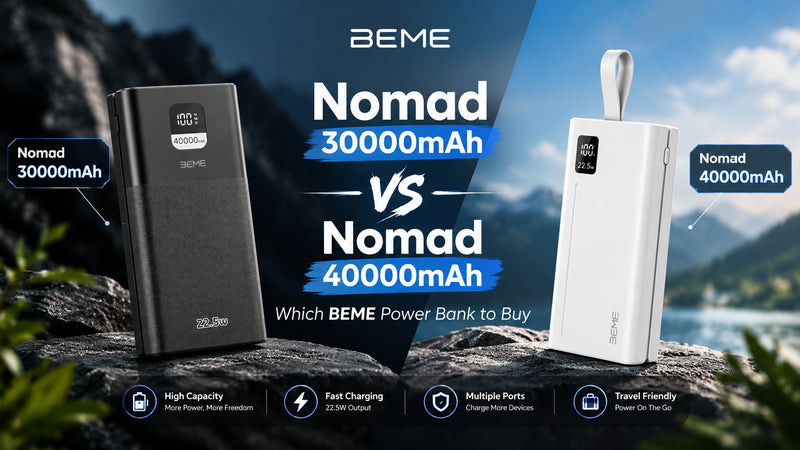
Both BEME Nomad power banks are built for the same job: keeping several phones charged through long load shedding hours, road trips and busy days. The difference is how much power you need and how many devices you charge at once. In this comparison of the Nomad 30000mAh vs Nomad 40000mAh, we look at capacity, ports, charging speed and real world phone charges, so you can choose the right one with confidence. Quick Comparison Feature Nomad 30000mAh Nomad 40000mAh Capacity 30000mAh 40000mAh (148Wh) Type C output Up to 20W PD Up to 20W PD USB A output Up to 22.5W Up to 22.5W on one port, 15W on two more Fast charging PD and Quick Charge 4.0 22.5W PD Display LCD battery display Digital battery percentage display Charging input Type C and Micro USB Type C and Micro USB, up to 18W Colour White Black Best for Small to medium families, road trips Large families, long outages Capacity: How Much Power Do You Really Get? Capacity is the biggest difference between the two. The Nomad 40000mAh holds one third more energy than the Nomad 30000mAh. No power bank delivers its full rated capacity, because energy is used in voltage conversion and lost as heat. In real use, power banks typically deliver 60 to 70 percent of their rating. Here is what that means for your phone: Phone battery size Nomad 30000mAh Nomad 40000mAh 3500mAh (compact phones) About 5 charges About 7 charges 4500mAh (mid size phones) About 4 charges About 5 to 6 charges 5000mAh (most Android phones) About 3 to 4 charges About 5 charges 6000mAh (big battery phones) About 3 charges About 4 charges These are estimates. Actual results depend on your phone, cable and whether you use the phone while charging. Ports: How Many Devices Can You Charge? Nomad 30000mAh The Nomad 30000mAh offers a Type C PD port and USB A output. It is ideal when one or two people charge at the same time. Nomad 40000mAh The Nomad 40000mAh has five ports in total: dual Type C plus three USB A ports. One USB A port delivers up to 22.5W and the other two deliver up to 15W each. This makes it the better choice when a whole family plugs in at once during an outage. When several devices are connected, total output on the Nomad 40000mAh is shared up to 22.5W, so each phone charges a little slower than it would alone. Charging Speed Both power banks offer up to 20W PD on Type C, which fast charges iPhone 8 and newer models and most modern Android phones. Both also reach up to 22.5W on USB A. For a single phone, charging speed is effectively the same on both models. The Nomad 30000mAh also lists Quick Charge 4.0 support on USB A, which some Android phones use for fast charging. Neither model is designed to charge laptops. For that, the BEME Pulse 100W is the right choice. Recharging the Power Bank Both models can be recharged through Type C or Micro USB. Since the Nomad 40000mAh holds more energy, it takes longer to recharge from empty at the same input speed. Plan to plug it in as soon as the power returns after load shedding. Size and Portability Higher capacity means a larger battery inside. The Nomad 30000mAh is the easier one to carry in a backpack every day, while the Nomad 40000mAh works best as a home base or a car companion on long trips. Which BEME Nomad Should You Buy? Choose the Nomad 30000mAh if you: Live with one to three people who need backup during load shedding Want a power bank you can also carry in a backpack Use Android phones that support Quick Charge Want strong capacity at a more affordable price Choose the Nomad 40000mAh if you: Have a large family that charges several phones at the same time Face long daily outages and want the most backup possible Take long road trips where several passengers need charging Want more ports in one device Frequently Asked Questions What is the difference between Nomad 30000mAh and Nomad 40000mAh? The Nomad 40000mAh has more capacity and five ports, including three USB A ports. The Nomad 30000mAh is smaller, more affordable and supports Quick Charge 4.0 on USB A. Which charges faster, Nomad 30000mAh or 40000mAh? For a single phone, both charge at similar speeds, with up to 20W PD on Type C and up to 22.5W on USB A. How many phones can the Nomad 40000mAh charge at once? It has five ports, so you can connect several devices together. The total output is shared when multiple devices are connected. Is a 40000mAh power bank worth it? It is worth it for large families and long outages. For one or two people, the Nomad 30000mAh usually gives enough backup. Can I take a Nomad power bank on a flight? Both are above the common 100Wh airline limit. The Nomad 40000mAh is rated at 148Wh, and the 30000mAh model is about 111Wh by standard calculation, so check with your airline before travelling. Can the Nomad power banks charge a laptop? They are designed for phones and small devices. For laptops, choose the BEME Pulse 100W. Conclusion Both BEME Nomad power banks are reliable choices for Pakistani homes and travellers. The Nomad 30000mAh is the balanced pick for smaller families and everyday carry. The Nomad 40000mAh is the power station for big households and long outages. Choose the capacity that fits your home, and you will never be stuck with a dead phone when the lights go out. Shop the BEME Nomad 30000mAh | Shop the BEME Nomad 40000mAh
Read Article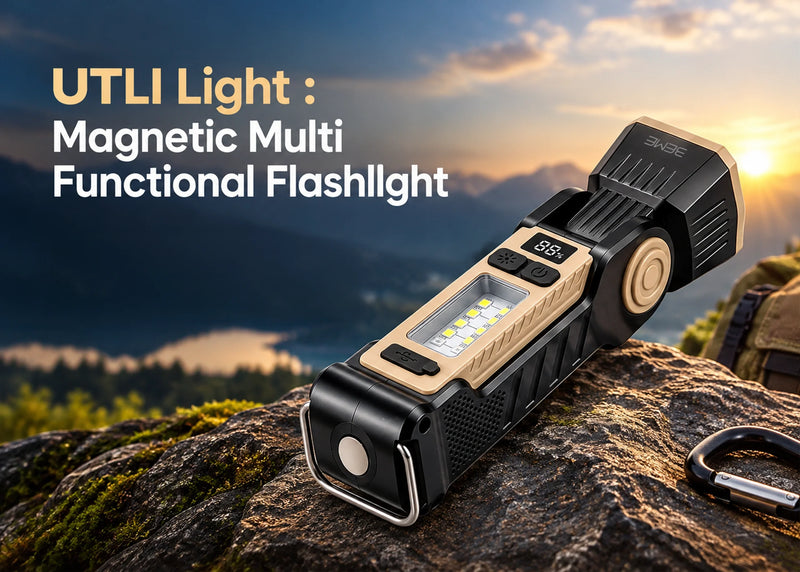
Some tools earn their place by doing one small job when you least expect to need it. The BEME UTLI Light Multi Functional Flashlight is a compact utility light that sticks to metal with a magnet, swivels its head 90 degrees, and carries a seat belt cutter. It is made for the glovebox, the toolbox, and the pocket. It is priced at Rs. 2,799, down from Rs. 3,999, and the page lists it as in stock. Quick Facts Light modes: 5 modes, with 4 brightness levels. Head: adjustable up to 90 degrees. Magnetic holder, carabiner hook, and pocket holder. Built in seat belt cutter and a pen holder. Battery: 18650, 1200mAh, with Type C charging. Charging time: about 5 hours. Battery life: about 1.5 to 2 hours. Power: 0.3W to 12.5W. Lighting: 8 white, 2 red, and 2 blue LEDs. Material and weight: ABS, 127g net. Display: a digital display for battery status. The Magnet Changes How You Use It Hold a torch in one hand and your work shrinks to one hand. The magnetic holder lets the UTLI Light stick to a compatible metal surface, such as a car bonnet, a toolbox, a metal shelf, or a fridge, and light the job while both hands stay free. It only attaches to magnetic metals, so it will not stay on aluminum, plastic, or glass. Test it on your own surface before you rely on it. The Swivel Head The 90 degree head turns the light from a forward beam into a downward one, so you can place it on its side and aim it where you need it. That makes it more useful than a fixed torch when you are working under a bonnet, on a bike, or in a corner of a room. The Seat Belt Cutter This is the feature that makes it a glovebox item. BEME describes it as a built in seat belt cutter to help respond in vehicle emergencies. It is a tool you hope never to use, but one that is much more useful in the car than in a drawer at home. A few honest points apply. Keep it where you can reach it from the driver's seat, not buried in a bag. Know how the cutter works before you ever need it. And treat it as an extra safety tool, not a replacement for wearing a seat belt or for proper vehicle safety habits. The Light Modes and Colors The UTLI Light offers 5 modes and 4 brightness levels, and the red and blue LEDs add signal options for emergencies. Brightness is not stated in lumens, but the power range of 0.3W to 12.5W shows how wide the range is between its lowest and highest settings. For everyday use, a lower level is usually enough and saves battery. The Battery: Plan Around It The honest limit is battery life. BEME lists about 1.5 to 2 hours of use, and about 5 hours to charge. That is short compared to larger torches, so this is not a light to run for a whole evening at full power. Charge it before a trip, keep it at a lower brightness when you can, and treat it as a utility and emergency light, not a main source of light. Where It Fits in Daily Life In the car, as a glovebox light with a belt cutter. On car repairs, stuck to the bonnet or frame. In a toolbox or garage, as a magnetic work light. On a bag or belt, using the carabiner or pocket holder. During load shedding, as a small light on the fridge or a metal shelf. UTLI Light or Other BEME Lights If you need to stand a light up on a table and work under it, the BEME Tool Beam Multi Functional Flashlight comes with a tripod and a mounting bracket, has a front beam and a COB side lamp, and is priced at Rs. 2,499. If you need distance, the BEME Torch Light Ultra Tactical Flashlight lists a range of up to 1.5 kilometers at Rs. 2,199. The UTLI Light is the one for magnetic hands free use and for the car. What Buyers Say All 6 reviews on the page are five stars. Buyers mention the swivel head, the strong magnet, the Type C charging, and the seat belt cutter. These are early reviews of a newly listed product, so judge it on the specs as well. Before You Buy Decide whether a short runtime suits your use. Check that your car or tool surfaces are magnetic. Keep it charged and within reach. Check the current price on the product page, since BEME prices change during sales. The Takeaway The UTLI Light is a small, practical light with a few clever extras. It is best as a magnetic work light and a car emergency tool, and its short battery life is the main thing to plan around. Keep it in the glovebox, keep it charged, and it will be ready when you need it.
Read Article
The most common reason a small power bank fails you is not its battery. It is the cable you forgot at home. The BEME Explorer Mini 3 5000mAh Powerbank is built around that problem. It has a built in Type C cable, a rotatable Type C connector, and a Type C to Lightning converter in the box, so it can charge without a separate cable. It is priced at Rs. 3,499, down from Rs. 4,999, and the page lists it as in stock in black. Quick Facts Capacity: 5000mAh, listed as 18.5Wh. Fast charging: PD 22.5W on the cable output and PD 20W on the connector output. Built in connectivity: a Type C cable and a rotatable Type C connector. Included extra: a Type C to Lightning converter. Display: real time LED battery display. Stand: a built in foldable stand. Input: Type C, listed at 5V at 3A and 9V at 2A. Why a Built In Cable Matters Think about when you actually use a small power bank. You are rushing out, in a rickshaw, or sitting in a waiting room, and your phone is at 10 percent. A power bank with no cable is useless in that moment if the cable is in another bag. With a cable built in, the power bank is ready whenever you are. It is a small thing that removes the most common point of failure. The Connector and the Lightning Converter The Explorer Mini 3 lists both a built in Type C cable and a rotatable Type C connector, which makes it easy to plug in at different angles. Most new phones, including recent iPhones, use USB C, so they connect directly. If you have an older iPhone with a Lightning port, the included Type C to Lightning converter handles it. That means one small power bank can serve a household with both kinds of phone, without carrying anything extra. The Foldable Stand A small detail that shows real thinking. The built in foldable stand lets you prop the power bank up while it charges your phone, so you can watch a video or keep an eye on a map. Used with a phone attached, it works as a tiny desk setup. It is a convenience feature, not a reason to buy on its own. What You Actually Get From 5000mAh A power bank delivers roughly 65 percent of its rated capacity because of conversion losses. With 18.5Wh, that is about 12Wh of usable energy, and a typical phone battery holds somewhere around 15Wh to 19Wh. In plain terms, expect a partial to near full charge for one phone, depending on its battery size. This is an estimate, and real results vary. It is a power bank for a daily top up, not for a long outage or a multi day trip. Charging It Back Up The Type C input lists 5V at 3A and 9V at 2A, so it accepts up to about 18W. At that speed, refilling 18.5Wh takes roughly an hour to an hour and a half in good conditions, and a bit longer in real life. Use a Power Delivery charger for the fastest refill. Who It Suits Commuters and students who want one pocket sized power bank with no loose cable. People with mixed phones, since the converter covers Lightning. Anyone who forgets cables and wants one thing less to remember. Travelers who want a light backup. At 18.5Wh, it is far below the 100Wh airline limit. Who Should Look at Something Else If you prefer cable free charging, the BEME Dual Mag 5000mAh Wireless Power Bank snaps onto a compatible phone magnetically and offers 10W wireless charging with 20W wired charging, at Rs. 3,999. It needs an iPhone 12 or newer, or a magnetic ring case on other phones. If you need more than one charge, the BEME Nomad 30000mAh Power Bank stores about six times the energy at Rs. 6,999, but it has no built in cable and is much larger. What Buyers Say All 7 reviews on the page are five stars. Buyers mention that it is travel friendly, that the LED display shows exact battery percentage, that the Lightning converter is useful, and that the foldable stand is handy. These are early reviews of a newly listed product, so judge it on the specs too. Before You Buy Decide whether you mostly use USB C or Lightning, check that 5000mAh is enough for your day, and check the current price and stock on the product page. BEME offers free delivery across Pakistan and Cash on Delivery. The Takeaway The Explorer Mini 3 is a simple idea done well. A small power bank that carries its own cable, handles Lightning, and stands up on a table. It is not meant for long outages, but for a daily top up it removes the part people forget most often.
Read Article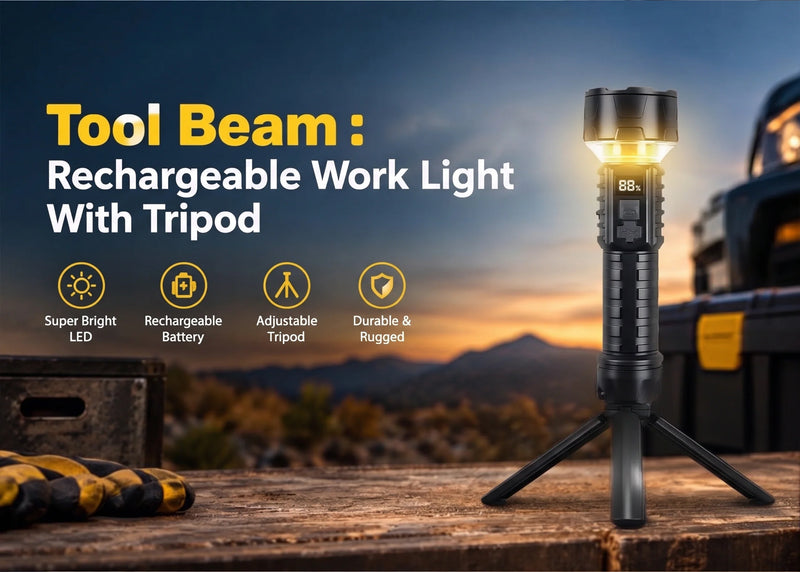
Most flashlights are built to be held. A lot of real jobs need both hands. Changing a tyre in the dark, fixing a bike chain, looking inside a car bonnet, setting up a tent, or finding a switch during load shedding all go better when the light stands on its own. The BEME Tool Beam Multi Functional Flashlight is built for that. It comes with a tripod and a mounting bracket, and it has two light sources, a front beam and a COB side lamp. It is priced at Rs. 2,499, down from Rs. 3,999, and the page lists it as in stock. Quick Facts Light sources: a front beam and a COB side lamp. Modes: 5 dynamic light modes, plus an SOS emergency function. Brightness: 5 levels. Included accessories: a tripod and a mounting bracket. Battery: a built in 1200mAh 18650 battery. Charging: Type C, listed at 5V and 500mA, with a charging time of about 5 hours. Water resistance: IPX4, which covers splashes. Display: a digital display for battery status. Materials: ABS, PP, and aluminum. Two Lights in One The front beam is for pointing at something. The COB side lamp spreads light across a wider area, which is better for lighting a work surface or a small space. Having both matters, because a narrow beam is poor for working on something close, and a wide lamp is poor for looking across a yard. Switching between them gives you the right light for the job without carrying two torches. The Tripod and Bracket This is the feature that sets it apart. The included tripod keeps the light steady and hands free, and the mounting bracket lets you position it where you need it. One buyer said the tripod ensured rock solid hands free positioning. For jobs that need both hands, this is more useful than any amount of extra brightness. Where It Helps in Daily Life Car and bike repairs. Prop it up under a bonnet or beside a wheel and keep both hands free. Camping. Stand it in a tent or on a table for area lighting. Load shedding at home. Place it on a shelf or table to light a room, or use it in the kitchen. Workshops and DIY. Light a work surface without holding anything. Emergencies. The SOS function gives you a signal light when you need one. What the Listing Does Not Say It is useful to know the gaps before you buy. BEME does not publish a lumen figure or a runtime in hours for the Tool Beam. The 1200mAh battery is modest, so expect runtime to depend on the brightness level, with the highest levels draining it fastest. The charging speed is also slow, at 5V and 500mA, which means about 5 hours for a full charge. Plan to charge it ahead of time, not when you need it. The listed IPX4 rating covers splashes, such as light rain, but not heavy rain or submersion. Tool Beam or a Regular Torch A regular torch is better when you need distance. The BEME Torch Light Ultra Tactical Flashlight lists a range of up to 1.5 kilometers and is priced at Rs. 2,199, which makes it the better choice for checking a yard or street. The Tool Beam is the better choice for standing a light up and working under it. Many households benefit from having one of each. Tool Beam or the UTLI Light If you drive often and want a magnetic light that also acts as a safety tool, the BEME UTLI Light Multi Functional Flashlight has a magnetic base, a 90 degree swivel head, and a built in seat belt cutter, at Rs. 2,799. It has a shorter listed battery life of about 1.5 to 2 hours. The Tool Beam has the tripod and the wider side lamp, while the UTLI Light has the magnet and the belt cutter. What Buyers Say All 9 reviews on the page are five stars. Buyers praise the tripod stability, Type C charging, and use for camping and emergencies. One mentioned that light rain was not a worry because of the IPX4 rating. These are early reviews of a newly listed product. A Quick Buying Checklist Decide whether you need a hands free light or a long range torch. Charge it fully before a job, since charging takes about 5 hours. Keep it dry and out of heavy rain. Check the current price on the product page, since BEME prices change during sales. The Takeaway The Tool Beam is a light you can set down and forget about while you work. The tripod and the two light sources make it useful for repairs, camping, and outages. It does not publish its brightness or runtime, so treat it as a practical work light for everyday tasks, not as a long range torch.
Read Article