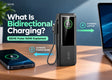


What Is Bidirectional Charging and Why the BEME Pulse 100W Uses It
 Muhammad Ahmad
Bidirectional charging is one of those terms that shows up on a spec sheet and gets skipped past, mostly because it sounds like something only engineers need to care about. In practice, it is one of the more useful things a power bank can actually do, and it is a big part of what makes the BEME Pulse 100W Powerbank 20000mAh work the way it does.
What Bidirectional Actually Means
A normal charging port usually has one job. Either power flows in, to charge the battery, or power flows out, to charge your device. Bidirectional charging means the same port can do both, sending power out when you need to charge a phone or laptop, and accepting power in when it is time to recharge the power bank itself. Instead of needing separate input only and output only ports, one Type C port handles the conversation in both directions, negotiating with whatever is plugged in to figure out which way the power should actually flow.
Why This Matters More Than It Sounds
Without bidirectional support, a high power port like this would usually need to be split into two, one for charging the power bank quickly, and a separate one for sending fast power out to a device. That means more ports, more complexity, and often a slower, more limited charging experience on at least one side of the equation. A single bidirectional port keeps things simpler while still supporting serious power in both directions.
How the BEME Pulse 100W Actually Uses It
On the BEME Pulse 100W Powerbank 20000mAh, the main Type C port handles up to 100W of output, genuinely enough to charge compatible laptops alongside phones and tablets, not just a token trickle. That same port also accepts up to 65W of input, which is what lets the power bank itself recharge quickly instead of sitting on a cable for hours. The built in Type C cable mirrors this setup at a slightly lower ceiling, supporting up to 60W in either direction, so even the convenience cable is not limited to a single job.
Alongside the bidirectional Type C port, a dedicated 22.5W USB A port stays available for a second device at the same time, and a real time digital LED display shows the exact battery percentage, useful for knowing how much capacity you actually have left whether you are charging out or charging in. A 20,000mAh battery backs all of this with real capacity, and 10 layer protection covers overheating, overcharging, overcurrent, and short circuits, which matters more once a single port is regularly handling both high speed charging in and genuinely high wattage charging out.
The Simple Way to Think About It
A regular power bank is a one way street, power only ever flows out to your device until the battery runs out and needs a separate charge later. Bidirectional charging turns that same port into a two way street, capable of sending serious power out when you need it and taking serious power back in when it is time to top up, without forcing you to hunt for a different cable or port depending on which direction you actually need in that moment.